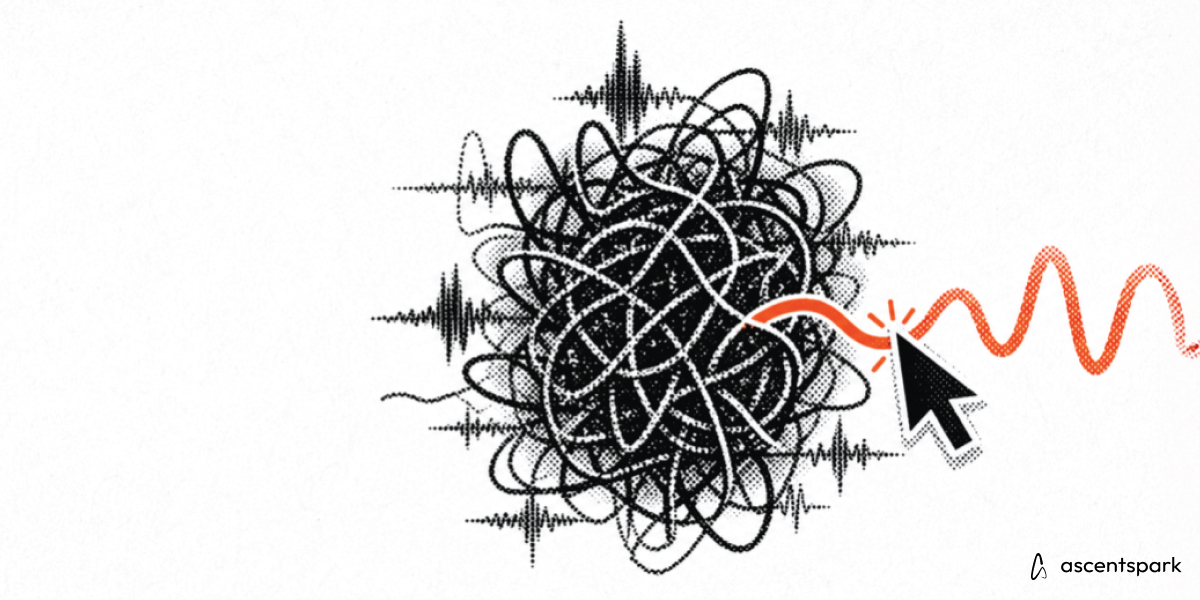
I've watched a particular scene play out enough times that it's started to feel like a script. A founder comes in having spent real time and real money on some flavour of "AI for the business." Sometimes it's a custom GPT, sometimes it's a chatbot bolted onto a CRM, sometimes it's a collection of automations stitched together with hope and duct tape. And the question is always some version of the same thing: why isn't it doing more?
The honest answer, most of the time, is that they bought the wrong category of tool for the job they actually needed done. Not because they're not smart, but because the people selling these things have made the categories deliberately blurry. Skills, GPTs, agents, assistants, copilots, autonomous systems, it all gets thrown into the same bucket with the same pitch. So let's sort the bucket out.
Think of a skill as a trained, repeatable capability with a tightly defined boundary. It does one thing well. Classify this text. Extract these fields from that document. Score this lead against these criteria. A skill is not a workflow in itself; it's a component you'd use inside one.
The confusion starts because skills often sit inside larger products and get marketed as the whole thing. You're not buying a skill when a vendor shows you their "AI-powered inbox" or their "smart document reader." You're buying a product that has several skills assembled inside it. The skill is the ingredient, not the meal.
Skills are extremely valuable. In my experience, they're where AI earns its keep most reliably, because the task is concrete and the output is measurable. But if you need something that orchestrates a process rather than just executing one step of it, a skill alone won't carry you.
A GPT, in the way most founders encounter it, is a conversational interface powered by a large language model. You give it a prompt; it gives you a response. You give it a follow-up; it adjusts. It's extraordinarily good at generating, summarising, drafting, explaining, and generally handling language tasks where the quality of a single response is what matters.
The critical thing to understand about a GPT is this: it is reactive. It waits for a prompt. It does what you ask, then it stops. Its sense of state is fragile and largely confined to the conversation window. Memory features are being bolted on, which is useful, but the base architecture is not built around persistence or initiative. A GPT does not wake up tomorrow and continue the task you left half-finished today.
Adding "Actions" to a GPT so it can call your API does not make it an agent. What you have is a reactive system that can now poke an external service when you ask it to. That's meaningfully more useful than a plain GPT, but the initiative still sits entirely with the person typing the prompt.
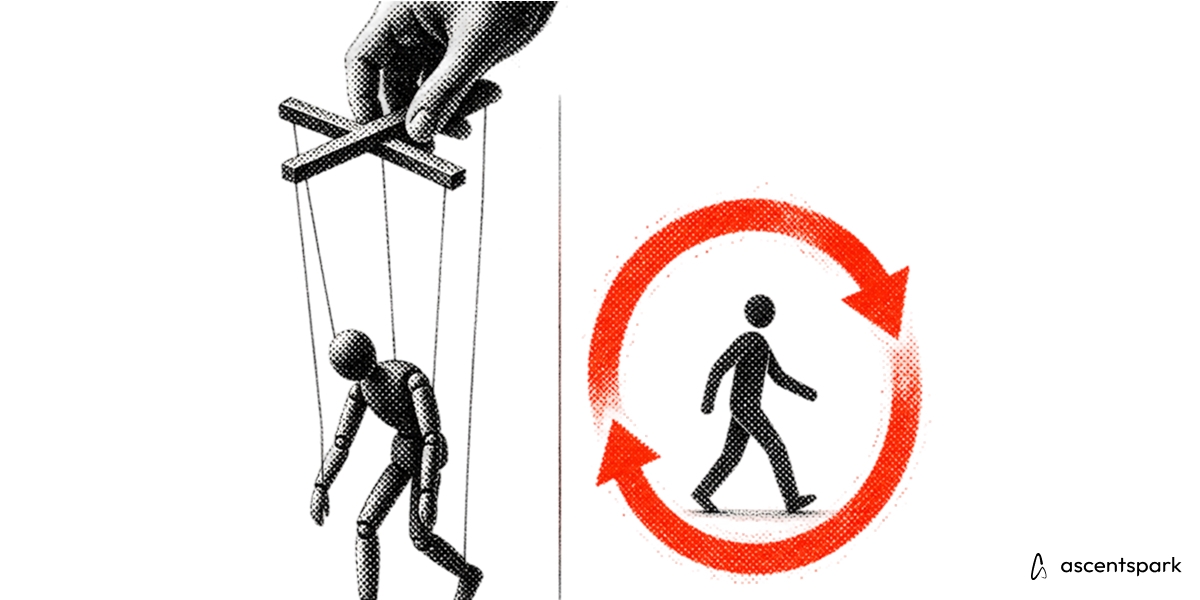
I'll put this as directly as I can: if the workflow stops moving the moment a human stops interacting with the interface, what you have is a very capable assistant, not automation that owns the workflow.
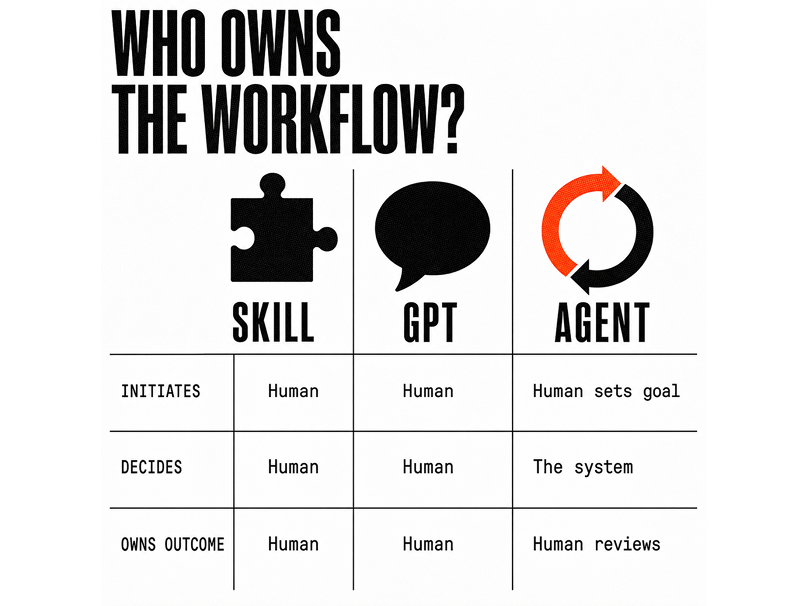
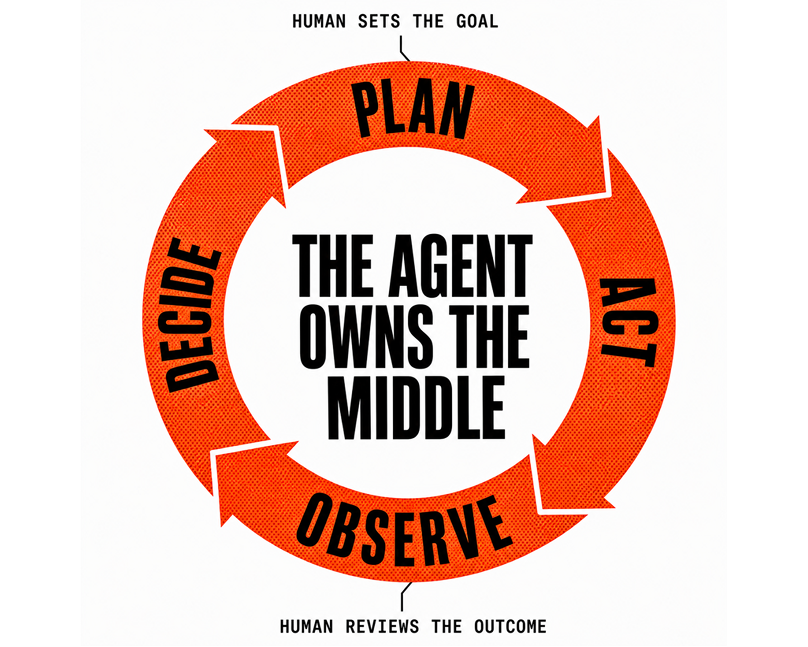
An agent is a system organised around a goal, and it loops.
Give it an objective. It plans, takes an action, observes the result, decides whether it's closer to the goal or not, and either continues or adjusts. That loop runs without someone sitting there nudging it forward at every step. The human sets the goal and reviews the outcome. The middle, often the expensive, time-consuming, error-prone middle, is the agent's job.
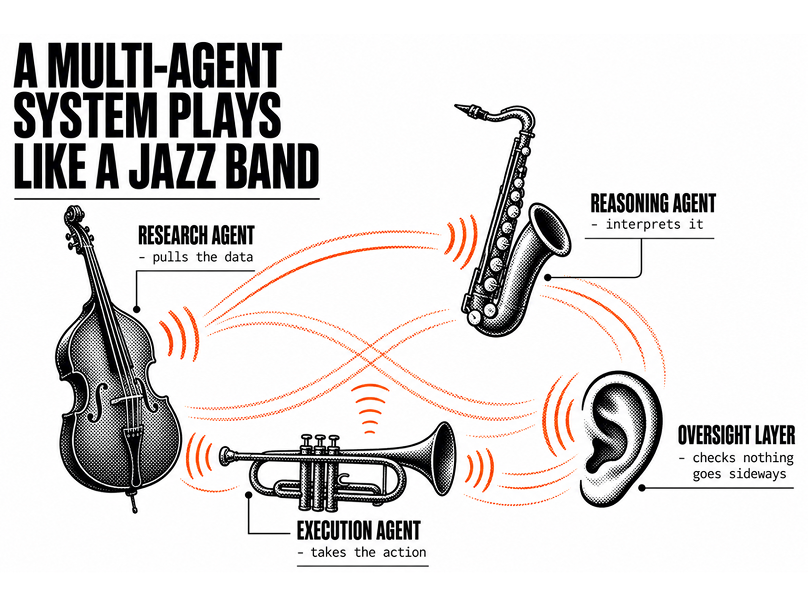
I like to think about it the way a good jazz band works. Each musician has their specialty, and they're all good at it. But they're also listening to each other, adapting in real time, and working toward a shared outcome that none of them could produce alone. A multi-agent system operates similarly: a research agent pulls the data, a reasoning agent interprets it, an execution agent takes the action, and an oversight layer checks that nothing has gone sideways. The whole thing moves together.
This is what "owning the workflow" actually means. Not a chatbot that can answer questions about your workflow, but a system that runs the workflow, hands off between steps, handles exceptions where it's been taught to handle them, and surfaces the ones it hasn't.
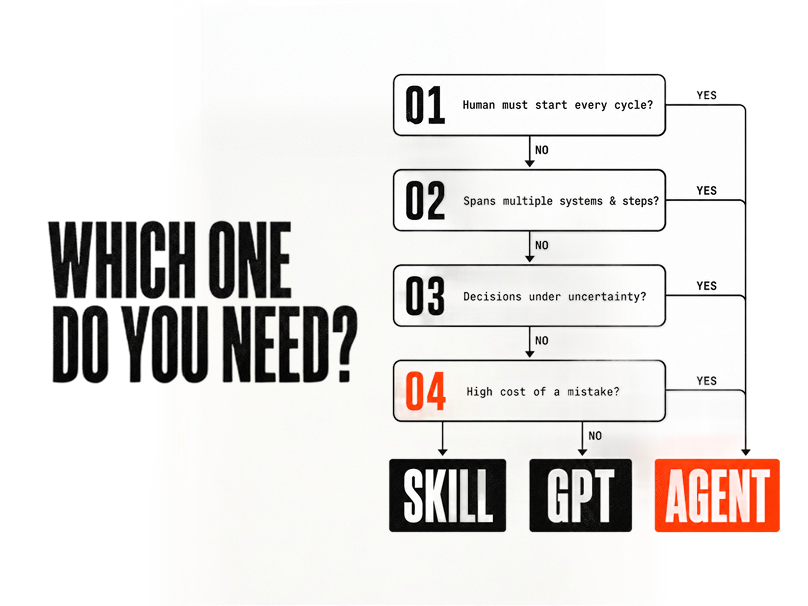
Here's a decision framework I've used with founders across a range of business sizes and industries. Answer these four questions honestly:
1. Does the task require a human to initiate every single cycle? If yes, a GPT or a skill might be all you need. If the task should be running without that prompt, you're in agent territory.
2. Does the task span multiple systems or steps where the output of one feeds the input of the next? A skill handles one step. A GPT with Actions handles a small number of steps if you're there to direct them. An agent handles a chain.
3. Does the task require decisions under uncertainty? "If the document says X, do Y; if it says Z, escalate to a human" is a decision tree, and you can hard-code it. But if the conditions are messier than that, and in most real businesses they are, you want an agent that can reason about what to do rather than fail silently when reality doesn't match the flowchart.
4. What's the cost of a mistake? This one matters more than founders usually expect. An agent that's trusted to act autonomously in a low-stakes process (scheduling, data enrichment, internal reporting) can operate with light supervision. An agent touching customer communications, financial records, or compliance-sensitive data needs tighter guardrails and human-in-the-loop checkpoints at key stages. In my experience, that failure mode, the half-supervised agent running loose in a high-stakes workflow, causes more damage than almost any other mistake in AI implementation.
Here's where I want to be direct about something the hype cycle glosses over.
Agents are genuinely powerful. They're also genuinely more complex to build, deploy, and maintain than a GPT wrapper. They need clear goal definitions, which is harder than it sounds. They need well-scoped tools, which requires actual integration work. They need failure handling, because they will encounter situations their designers didn't anticipate. And they need ongoing tuning as your business processes evolve.
None of that is a reason not to build them. It's a reason to go in with accurate expectations and a budget that reflects the real scope of the work.
The founders who get the most from agents are the ones who start with a specific, high-value workflow rather than a vague mandate to "automate the business with AI." Pick the process that's eating the most manual hours, has clear inputs and outputs, and doesn't require a human judgment call at every step. Build the agent for that. Measure it. Then expand.
The ones who struggle are, typically, the ones who bought a demo and assumed the demo was the product. A GPT that looks impressive in a 20-minute walkthrough is not the same thing as an agent that's been designed, integrated, tested, and deployed against a real production environment.
If you're a founder trying to figure out where to put your AI spend, here's the short version:
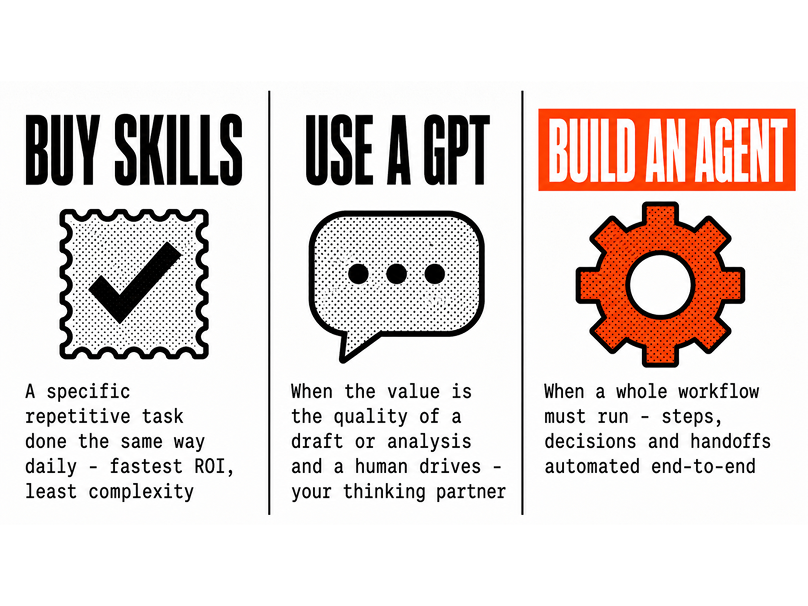
Buy skills when you have a specific, repetitive task that's currently being done by a person clicking through the same steps every day. The task is well-defined, the inputs are consistent, and you can measure the output quality. This is where you'll often get the fastest ROI for the least complexity.
Use a GPT when the value is in the quality of a response, a draft, an analysis, or a summary, and a human is in the loop directing that conversation. This is your thinking partner, your first-draft machine, your research accelerator. Valuable, but it doesn't replace the human driving it.
Build an agent when you need a workflow to run, not just a task to be completed on demand. When the sequence of steps, the decisions between them, and the handoffs across systems are the thing you want automated, that's what agents are built for.
The map isn't complicated once you strip away the marketing. It's really a question of: who's doing the initiating, who's doing the deciding, and who's responsible for the outcome at each step? Answer that honestly for the workflow you're trying to fix, and the right category becomes fairly obvious.
So do the thinking first, and let the map do the rest.
TL;DR
What is the difference between a skill, a GPT, and an agent? A skill does one specific task well (like classifying text); a GPT is a conversational tool that responds when you prompt it; an agent is a system that pursues a goal on its own, looping through steps without needing a human to push it forward at every stage.
When should a founder use a GPT instead of an agent? Use a GPT when you need quality responses, drafts, or analysis and a human is already in the loop directing the conversation. If the work stops the moment no one is typing, a GPT is the right fit.
What does it actually mean for AI to "own" a workflow? It means the system runs the process, passes work between steps, handles exceptions it has been taught to handle, and flags the ones it has not, without needing a human nudge at every stage.
What is the biggest risk with AI agents? Giving an agent too much freedom in a high-stakes area (customer communications, financial records, compliance) without proper checkpoints. A half-supervised agent in a sensitive workflow can cause more damage than almost any other AI mistake.
Where should a founder start if they want to build an agent? Pick one specific, high-value workflow that eats the most manual hours, has clear inputs and outputs, and does not require a human judgment call at every step. Build for that first, measure results, then expand.