There is a party trick the human brain performs so effortlessly that we forget it is a trick at all. You sit in a crowded room, dozens of conversations overlapping, glasses clinking, music playing, and yet you can lean in and follow a single voice across the table. Psychologists call it the cocktail party effect. Engineers, when they try to reproduce it in software, tend to call it a nightmare.
So when Meta released SAM Audio on 16 December 2025, my first reaction was less about the marketing line and more about the underlying problem it dares to take on. Isolating one sound from a dense mixture of many is genuinely hard. It is the audio equivalent of trying to un-bake a cake and pull out just the eggs.
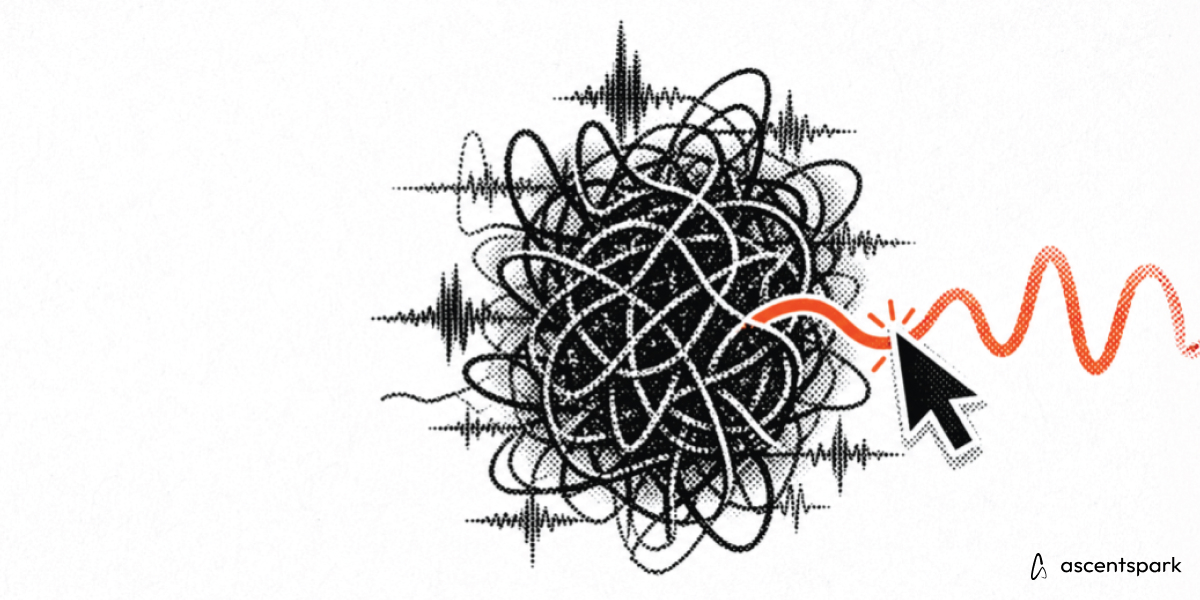
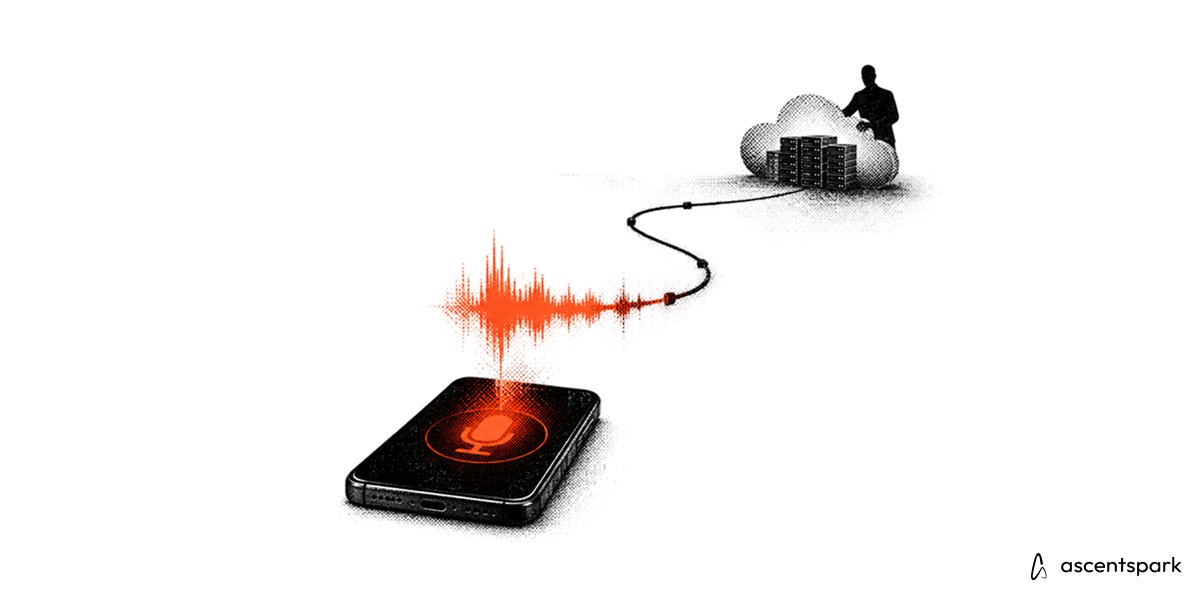
SAM Audio is a unified multimodal model for audio separation. The core idea is that you can point at a sound the way you would point at an object in a photograph, and the model pulls that sound out of the mixture for you. What makes it interesting is the variety of ways you are allowed to point.
You can prompt it with text, asking it to isolate a particular sound from a noisy recording. You can prompt it with a visual cue, so clicking on the guitarist in a video of a band performance can tell the model which sound source you mean. And there are what Meta calls span prompts, where you identify a point or stretch of time in which the target sound occurs.
If a dog barks during part of a recording, for example, that segment can serve as a temporal cue identifying the unwanted sound.
That last one is the part I keep coming back to. Meta describes span prompting as an industry first, and I understand why. Instead of having to describe a sound perfectly in words, you can effectively tell the model: this sound, here — that's the one I mean.
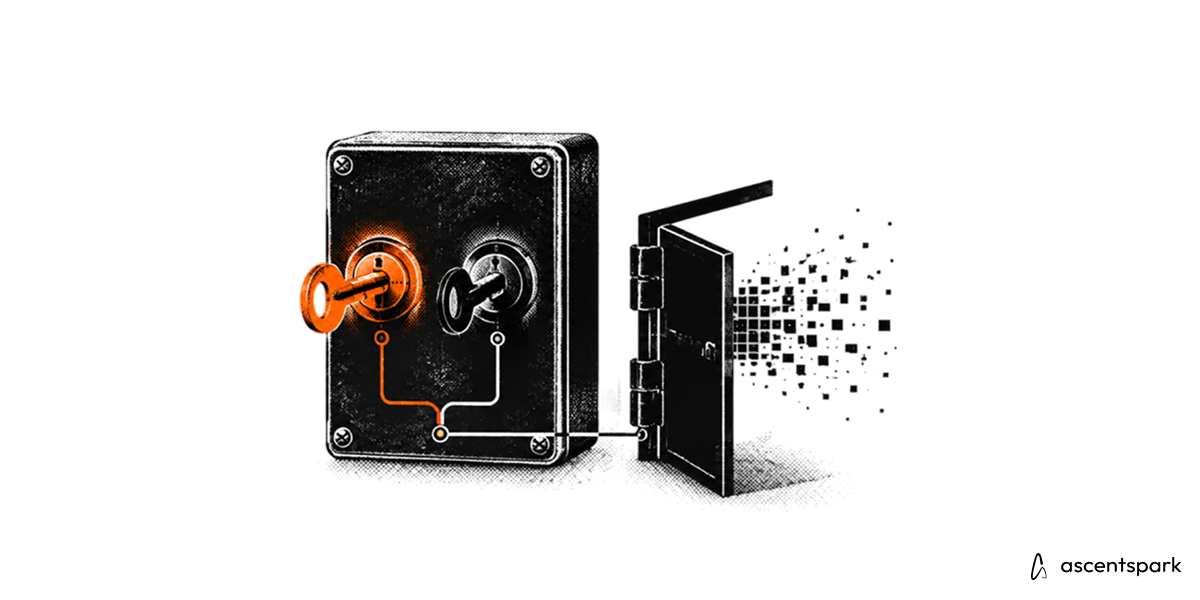
Underneath that deceptively simple interaction is a generative separation model built around a flow-matching diffusion transformer. Rather than merely identifying where a sound occurs, SAM Audio generates two outputs: the target audio you asked for and the residual containing everything else.
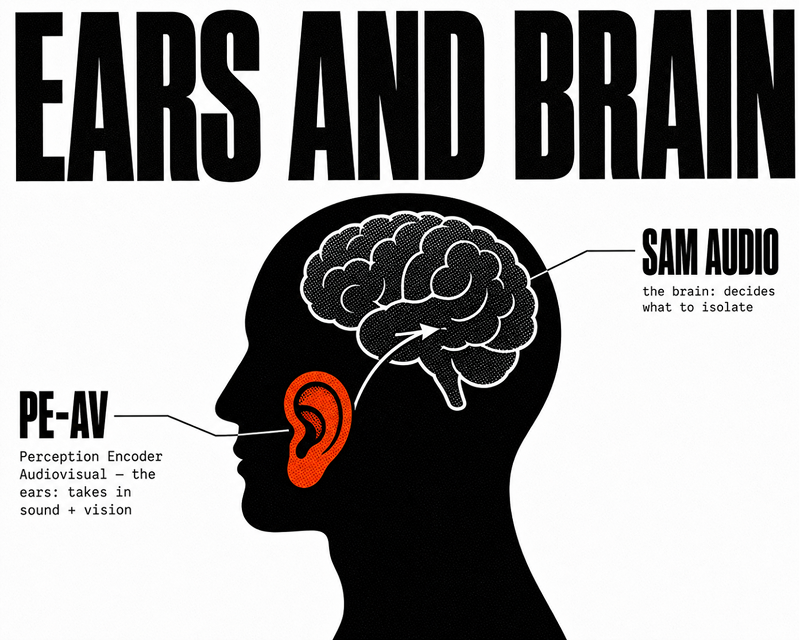
An important part of the broader system is Perception Encoder Audiovisual, or PE-AV, built on the open-source Perception Encoder model Meta released earlier in 2025. PE-AV provides audiovisual representations used across the system and powers components including Meta's primary captioning model and SAM Audio Judge.
Meta's own analogy is a nice one, so I will borrow it. PE-AV acts as the ears, while SAM Audio does the work of deciding what to do with what those ears take in.
Meta released SAM Audio and PE-AV alongside the announcement, with the latter available through GitHub.
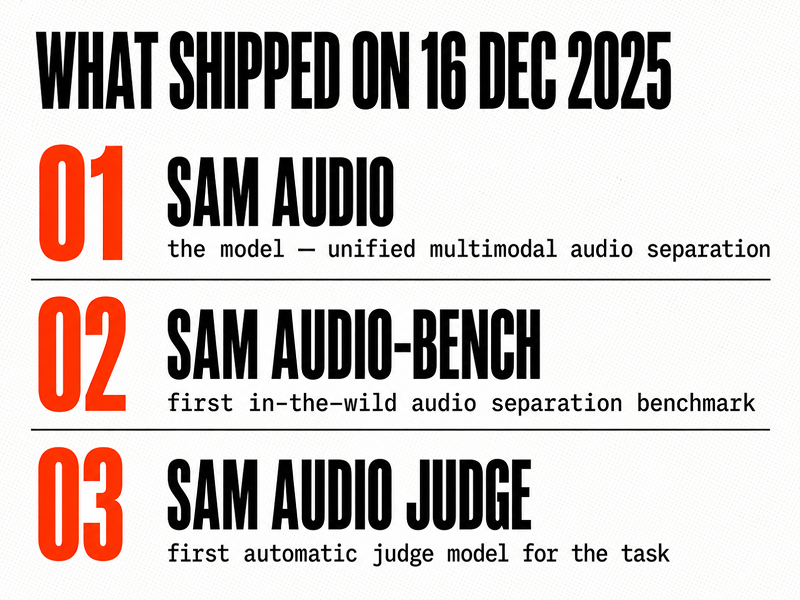
Alongside the model, Meta also released SAM Audio-Bench, which it describes as the first in-the-wild benchmark for audio separation, and SAM Audio Judge, an automatic evaluation model for the task. Anyone who wants to try SAM Audio directly can do so through the Segment Anything Playground, where it joins Meta's recent SAM 3 and SAM 3D releases.
Over the years, I have learnt to read releases like this from the bottom up. The flashy demo gets the headline, but the benchmark tells you whether the field is being serious.
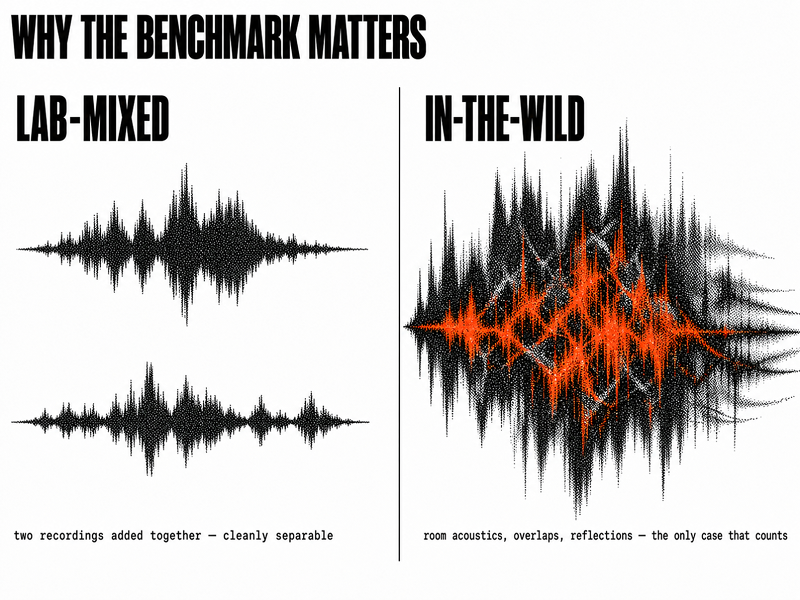
Here is the thing about audio separation. It has always suffered from a testing problem. A lot of academic work is validated on artificially mixed data, where researchers take separate recordings, combine them under controlled conditions, and then ask the model to pull them apart again.
That is useful for research because you know exactly what the correct separated sources are. But real recordings are not assembled that way.
Room acoustics, overlapping frequencies, reflections off walls, background noise, microphone characteristics, and the peculiar way a human voice and a violin can occupy some of the same acoustic space all make real recordings considerably messier. Laboratory mixtures can simulate some of those effects, but they cannot fully reproduce the peculiar messiness of sounds that were captured together in the real world.
An in-the-wild benchmark is Meta acknowledging that the messy case is the one that ultimately counts. That is a mature move. The eggs were never neatly separable to begin with, and pretending otherwise only makes a benchmark less representative of what happens outside the lab.
The judge model is the companion piece to this. Evaluating separated audio is difficult because "did it sound right?" is partly a perceptual question, and paying humans to rate thousands of clips does not scale.
Meta reports that SAM Audio Judge correlates strongly with human judgement, and importantly, the model was developed using human ratings across multiple perceptual dimensions. That is encouraging.
I would still want to see how that correlation holds across independent datasets and models outside Meta's own evaluation pipeline before treating the judge as a universal yardstick. That is not scepticism about Meta specifically. It is simply how one should read any self-issued yardstick.
What I find genuinely elegant is the lineage.
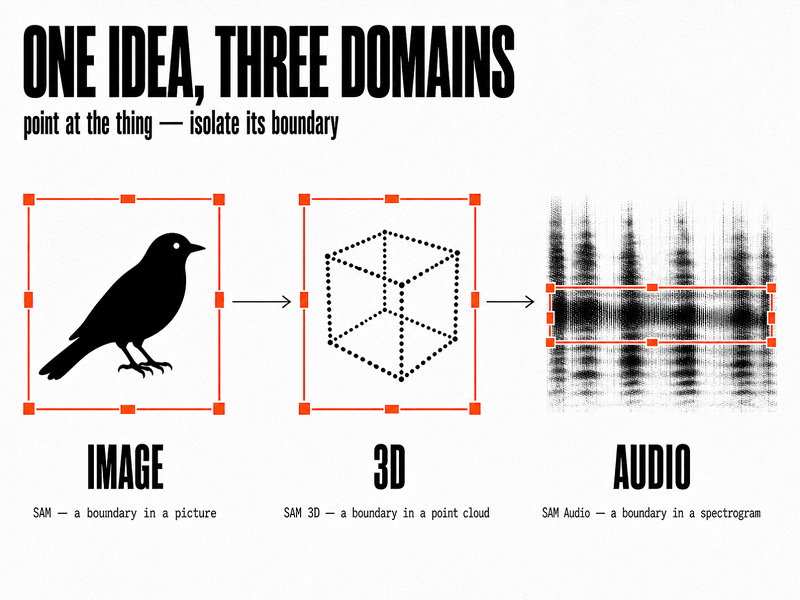
SAM began as a way to segment objects in an image. Point, click, and the boundary of the thing you meant appears. That same conceptual grammar — isolate the thing the human is pointing at — has now been carried into three dimensions with SAM 3D and into sound with SAM Audio.
This is first-principles engineering, and I admire it.
Meta did not simply ask, "how do we build an audio tool?" The more interesting question is: "what is the shape of the problem we already solved, and does that shape recur elsewhere?"
Segmentation, it turns out, is a shape that recurs.
A region in an image, a structure in three-dimensional space, a source inside a mixture of sounds. Different domains, but the same underlying question: which part of this complicated input is the thing the human means?
The implementation changes completely. The abstraction survives.
That kind of thinking is rarer than it should be. A lot of modern development bolts one clever model onto another and hopes the seams hold. Recognising that a useful abstraction can generalise across vision, three-dimensional space and audio is the difference between building another feature and understanding the underlying problem.
My interest in tools like this is less in the demo and more in what they change for people building real systems.
SAM Audio is not going to make a bad microphone sound like a studio. Information the microphone never captured cannot simply be conjured back. But there is an enormous middle ground: the podcast recorded in a café, the field interview with wind in it, the training video shot in an open office, the call recording with interfering voices, or the media workflow that needs to isolate particular sounds before feeding them into another system.
Tools like this shift what a small team can realistically do without building a specialised audio-processing pipeline for every problem.
There are also limits worth stating plainly.
SAM Audio still needs a prompt; it is not a magic "separate everything" button. Meta also acknowledges that separating highly similar sources remains difficult. Isolating one singer from a chorus or one instrument from an orchestra, for example, is still a hard problem.
And although the model has been publicly released, running it locally is not the same thing as deploying a tiny edge model. Meta's released SAM Audio family ranges from roughly 500 million to 3 billion parameters, and the official implementation recommends a CUDA-capable GPU. Developers interested in self-hosting should account for the compute requirements as well as the model itself.
In my view, this is the real story of the current AI moment, and I keep saying it because I keep being proven right. AI does not replace the thinker. It amplifies them.
A skilled editor who understands why a recording sounds bad can use a tool like SAM Audio to perform work that previously required considerably more manual effort. Someone who does not understand the underlying acoustics can still get lost regardless of how good the model becomes, because they may not know what they are listening for or what they should ask the system to isolate.
The prompt is only as good as the judgement behind it.
Depth beats breadth here too. The people who will get the most out of this are the ones who bothered to learn how sound actually works: what a formant is, why reverb is so difficult to remove, how frequencies mask one another, and why two sounds that appear obviously different to a human can be surprisingly difficult to separate mathematically.
The model handles the tireless, precise, mechanical part. The human supplies the judgement.
That partnership — human ingenuity paired with machine capability — is where the interesting work has always lived.
I have not run SAM Audio through my own recordings yet, so I am withholding a verdict on its real-world quality. What I will say is that the framing is right.
Making audio separation feel like pointing at a thing rather than tuning a rack of parameters is the correct instinct. The best tools disappear into the task. If this one does that reliably, it will matter far beyond the demo reel.
For now, SAM Audio can be explored through Meta's Playground, while the inference code and model resources have been publicly released under Meta's SAM License. I would encourage anyone who works seriously with sound to go and poke at it.
Just remember to bring your ears.
The model brought its own.
What is Meta SAM Audio?
SAM Audio is Meta's multimodal AI model for separating sounds from complex audio mixtures. It can isolate a target sound using text descriptions, visual cues from video, or temporal span prompts.
How do you tell SAM Audio which sound to isolate?
You can describe the sound in text, visually identify a sound-producing object or person in a video, or mark a time span in which the target sound occurs. These prompt types can also be combined.
What can SAM Audio be used for?
Potential applications include background-noise removal, speech and instrument separation, podcast and video editing, accessibility tools, media processing, and preprocessing audio for other AI systems.
What is SAM Audio-Bench?
SAM Audio-Bench is Meta's real-world audio separation benchmark covering speech, music and general sound effects. Unlike benchmarks based primarily on artificially mixed sources, it includes real-world audio and multimodal prompts designed to test separation under more realistic conditions.
What is SAM Audio Judge?
SAM Audio Judge is Meta's reference-free evaluation model for assessing separated audio using perceptual criteria. Meta reports that its evaluations correlate strongly with human judgements.
What are SAM Audio's limitations?
SAM Audio still requires a prompt and does not perform complete unprompted separation of every source in a recording. Meta also says that separating highly similar sources, such as one singer from a chorus or one instrument from an orchestra, remains challenging.
Is SAM Audio open source?
Meta has publicly released the SAM Audio inference code and model checkpoints under its SAM License. The official implementation recommends a CUDA-compatible GPU, and access to the model checkpoints is provided through Hugging Face.
Does SAM Audio replace audio engineers?
No. It can automate difficult source-separation work, but recording quality, acoustics, editing decisions and judging whether an output is actually usable still require human expertise.